Online Problem Solving – Problem Statement

A nice problem: Given n lines in general position, how many regions do they break the plane into? How many are bounded, and how many are unbounded? (In this picture, there are six lines, 10 bounded regions, and 12 unbounded regions.)  What if we work in 3 dimensions, with planes instead of lines? Can we generalize to k dimensional space?

One of the big discussions we’ve (myself, David Stern, Toni and Alan Beardon, and occasionally David Minga) been having these last couple weeks is, ‘How can we develop online materials that do a good job of teaching problem solving?’  In a lot of ways, a good problem solving course is one of the most important parts of an education in mathematics.  One gains a flexibility in approaching problems well beyond trying to reproduce an answer on an exam, and encounters numerous techniques and ideas that will motivate later coursework which might otherwise seem really dull.  (Linear algebra comes to mind: it’s stupidly important, but can seem really obtuse if you encounter it in a void.)  General problem solving skills also translate to a wide variety of contexts outside of mathematics: How do I approach this issue flexibly and adapt it into something I can address with the tools available to me?  Furthermore, can I solve bigger problems with my tools than the one immediately in front of me?

The best solving courses take the form of a conversation between students and teachers.  It’s about developing the skills to get started, to actually act on a problem creatively, rather than reproduce what a teacher tells you.  So a good problem solving course typically focuses on getting the students to actually solve problems, with a relatively small amount of guidance and advice from the instructor.

But this method is heavily reliant on reactive, non-linear instructor interaction.  Generally, it’s agreed that this is at the core of why it’s hard to put high-quality math courses on line.  How do you foster creativity with a computer interaction?

Continue reading

Pi+Sage

Running the RPi on a hotel TV, alongside an android phone providing a wireless network, and my plain old boring linux laptop. Terminals for everyone!

After a great deal of effort, I’ve finally finished compiling Sage 5.5 on the Raspberry Pi.  It seems to be basically functional; it starts and adds 2+2 successfully.  (So already it’s doing better than Trurl’s Machine.)  I’m currently running the full test suite, which could very well take a few days.  We’ll see when it gets there.  For now, here’s a link to a binary; drop me a line if you have trouble with it.  To get started, extract it with:

tar -xvpf sage-5.5-pi.tar.bz2

Then cd into the resulting directory and run “./sage” from the command line, or set up a link which runs “[full-path-to-sage]/sage -notebook()]”, which will automatically open a sage notebook in a browser.

If you’re curious about building sage yourself, there are details after the jump.  It requires a bit of blood and something like 3 days of processor time, with somewhere south of 3 days of additional time used by the swap memory.

Continue reading

Some Thoughts on Aaron Swartz

Aaron Swartz, digital superhero.

Like many people, I’ve been fairly shocked at the suicide of Aaron Swartz a couple days ago.  Here’s some background, if you haven’t read anything about it: Cory Doctorow’s obit post, and Lawrence Lessig’s Prosecutor as Bully.

I have two trains of thought on all this: On the first, I think back to being in high school and coming up against systems that just carried on, not bothering to question their relationship to their underlying purpose.  Like an ‘American literature’ class which involved almost no actual reading, instead focusing entirely on grammar exercises.  Or an ‘independent study’ art class which led, by a strange run of events, to a suspension from school after the Columbine shooting, as the school administration cast about to get rid of any student who reminded them too much of the tragedy in Colorado.  The thing I had been working on was a comic book about the incredible tedium and irrational boundaries of life in an American suburb.  Through my time in school I developed this sense that the vision of the people running the show was too narrow to understand what was possible: the admins were so interested in maintaining a status quo that there was no possibility of examining underlying assumptions, or addressing the contradictions in a school that treats its students like prisoners.

And then I moved on, and life got better.

Aaron Swartz was constantly running up against the contradictions between the old world and the new digital society, and taking concrete actions that exposed those contradictions and forced the conversation forward.

Continue reading

Looking Backwards

Playing a local game (something like checkers-meets-tic-tac-toe) with a friend from Kibera. You can see Dominion: Prosperity is also on the table…

The term has come to a close, finishing the first half of my Fulbright year, which provides a bit of time to look back over what I’ve done, what’s worked well, and what’s worked less well.  A big part of the plan for the first time was to try out the existing structures, get to know what’s going on in the university, and figure out interesting ways forward that might work in the local context.  There were a lot of failures this term, places where things didn’t work as expected, where it’s clear that things need to happen differently next time around.  So if this post sounds bleak in some ways, rest assured that I’m already working hard on projects for next term that will try to get around these difficulties in one way or another.

  • Teaching Face-to-Face

    Despite my mandate to work on electronic education, I felt it was very important to teach a face-to-face course in order to better understand the undergraduate students and their context.  To that end, I co-taught Foundations of Mathematics with David Stern.

    The course went reasonably well, but has definitely made me consider the degree of work necessary to really address the problems in the education system. We were working with first-year students, which is ideal in many ways. It’s easier to do something revolutionary with first-years, simply because they haven’t lowered their expectations too far yet. (This was true even when I was teaching at the University of California; the first-years are a lot more open to non-traditional techniques, simply because they expect University to be different from secondary.) Continue reading

Fun with the Raspberry Pi

A raspberry pi. I still can’t get the HDMI output working, which makes it a bit anticlimactic. Need to pick up a component video cable….

One of the many projects we’re planning to run involves getting some Raspberry Pi computers into rural libraries and/or community centers and giving youths a chance to learn programming.  We’re particularly looking at bringing on just-graduated students, who typically hav about eight months of dead time between the end of secondary school and the start of university.

So I’ve gotten my hands on a couple RP’s; the last few days I’ve really started hacking around with one in particular.  My short-term goal is to get a working Sage binary together, built for the Pi.  (Admittedly, I haven’t tried the ARM binary at sagemath.org, but it claims to not be built for the particular processor in the Pi.) It will generally be a good public service to get a Pi-ready build of Sage out there in the world.  One will probably need an 8gb sd card to run it properly, though, as the binary will probably weigh in at a bit over 2gb.

Continue reading

Computational Problem Solving Workshop

Portrait of Euler, shamelessly lifted from Project Euler.

One of the things that we believe strongly is that there needs to be better use of computers in math education, in part because computers play such a huge role in how math is actually done these days.

To that end, I ran a one-day workshop on mathematical problem solving using Sage today. The idea is to run this workshop as a kind of seminar series next term, once we get back from South Africa, and today served nicely as a dress-rehearsal. The students who came today were all in first-years in computer science; it should be interesting to see how things play out with math students next term, who haven’t necessarily been exposed to the programming side of things as much.

Here’s how things went down:

Continue reading

David Ssevviiri Visit

A Colubus monkey, from Kakamega forest.

Dr. David Ssevviiri was in Maseno the last couple days; he’s a Ugandan mathematician currently in Kampala, educated in South Africa. David’s an incredibly bright guy, very interested in a kind of narrow research area of prime ideals (and prime modules) in ring theory.  But he has a voracious appetite for learning new things, and seemed very happy to soak up as much algebraic combinatorics as I was willing to throw at him.

One of the things that was really clear in our conversations was the need for easier connections between African mathematicians and the rest of the world mathematics community.  South Africa has been doing quite a lot (with plenty of international support) to ensure chances for the best mathematical brains in Africa to get a quality graduate education.  Unfortunately, when the resulting mathematicians go back home, they are often cut off almost completely from the broader research world.  This is because the research communities in most African countries are very small, and most of these countries don’t have a science budget to support research activities.  Since much of the research funding in the developed world comes from national agencies like the NSF (in the US), this means there are very few opportunities for Africans to receive funding.  Additionally, for international grants they are in direct competition with international researchers, and the University systems in Africa largely aren’t preparing people (yet) to be able to compete on level footing for these kinds of grants.

Continue reading

Explore, Conjecture, Test, Prove.

A spider web in Kakamega forest. Good accompaniment for a mathy post?

I’m spending the afternoon grading student papers from the Foundations course, and realizing that it might have helped to separate out the process of mathematics a bit more.  We gave them a take-home assignment to write up a proof that we discussed in class, in detail.  The issue is, though, that our classroom discussion included a lot of exploration and kind of side-conversations, which have worked themselves into the submitted proofs in interesting (in the not-great sense) ways.

There’s a great course in the Budapest Semesters in Mathematics program called ‘Conjecture and Proof,’ which combines a proof-writing class with a problem-solving class.  (But it’s really focused on the problem solving.)  In Foundations we’ve been striving to get across the importance of rigor and proof, while teaching basics of proof-writing and techniques of proof.  Inevitably, though, such a project has to be mixed with some problem solving alongside: students need to write proofs that they haven’t seen before, and that involves solving problems.  So we’ve ended up a bit reversed from the C&P structure, which places a lot more emphasis on the problem-solving than the proof writing.  (And I feel a bit like we’re falling on the wrong side of history in this sense…)

Continue reading

Crescent Island

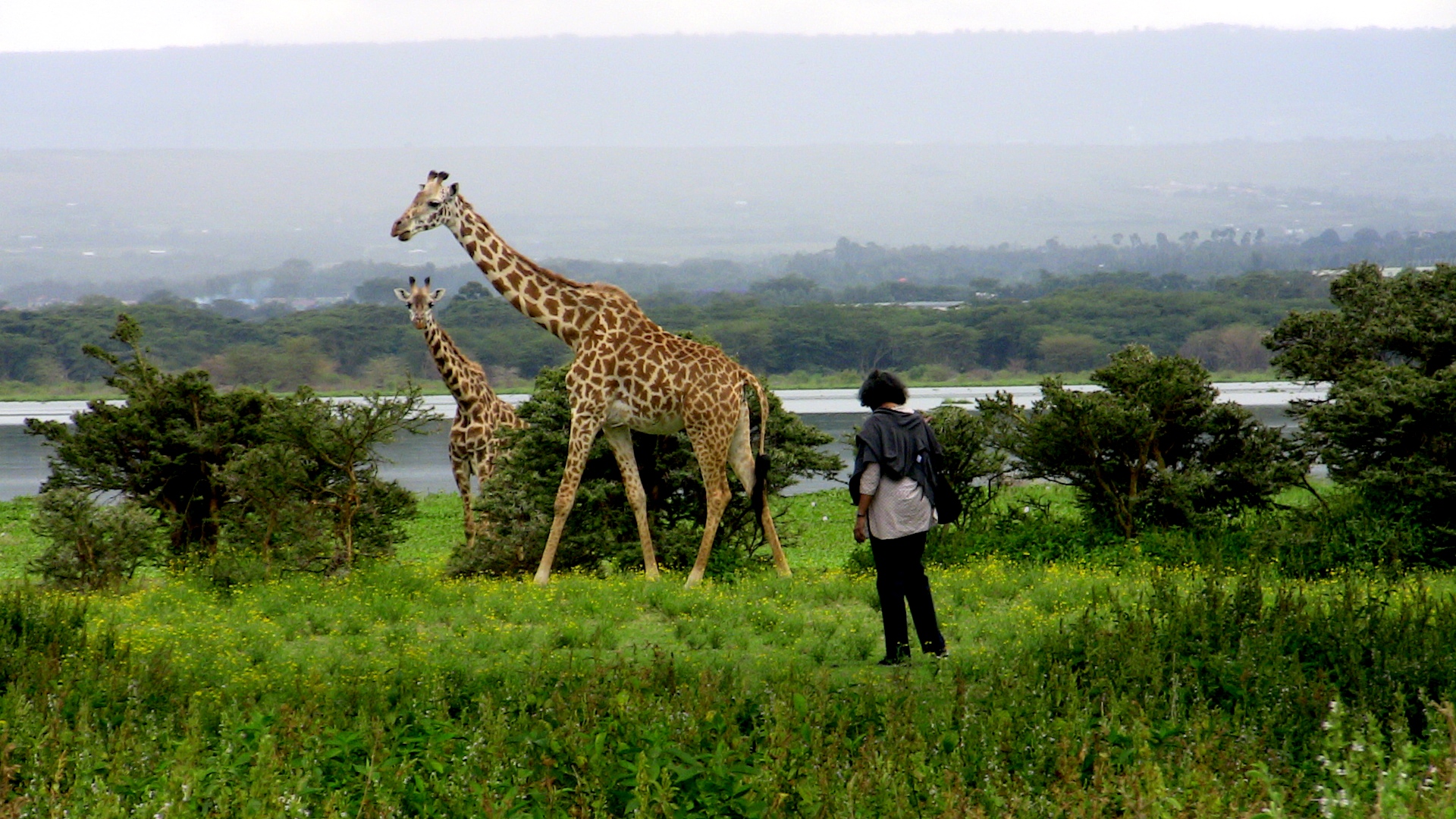
Uma Kambhampati wanders near some giraffes.

Elizabeth came into town on Thursday, which has been really fun!  On Saturday we took a trip to Crescent Island, on Lake Naivasha.  It’s where the film Out of Africa was filmed way back in 1985.  There weren’t any animals living on the island, though, so they shipped in a bunch of charismatic megafauna: zebra, gnu, Thompson’s gazelles, antelope, and, yes, giraffes.  There aren’t any predators to thin out the herds, so the island, while small, is really packed with animals.  And they’re pretty tame: one just walks around amongst them, no big deal.

Continue reading

Election Day (US Edition)

With Fulbright Scholar Erik Nordman and his wife Jen at the US Embassy’s election party.

I spent the morning of Wednesday, November 6th at the residence of the US Ambassador, where a big election-viewing party was taking place.  There were maybe three hundred people at the event, all told.  I went with a couple great Fulbrighters, leaving our hotel at 4:30 am to get to the residence at 5.  Of course, our travel calculations included time for traffic, which for some reason wasn’t bad at that hour, so we actually got to the show a bit early.

It was a very nice morning!  The party featured a mock-vote, which resulted in 166 votes for Obama, 44 for Romney, and 1 write-in vote for Hillary Clinton.  The crowd included lots of people working at the Embassy; I met people from USAID, the CDC, and the consulate, amongst others.  There were also around thirty or so secondary students who had been invited, along with some law students from the University of Nairobi who were very friendly.  And yeah, lots of free coffee.

Continue reading